
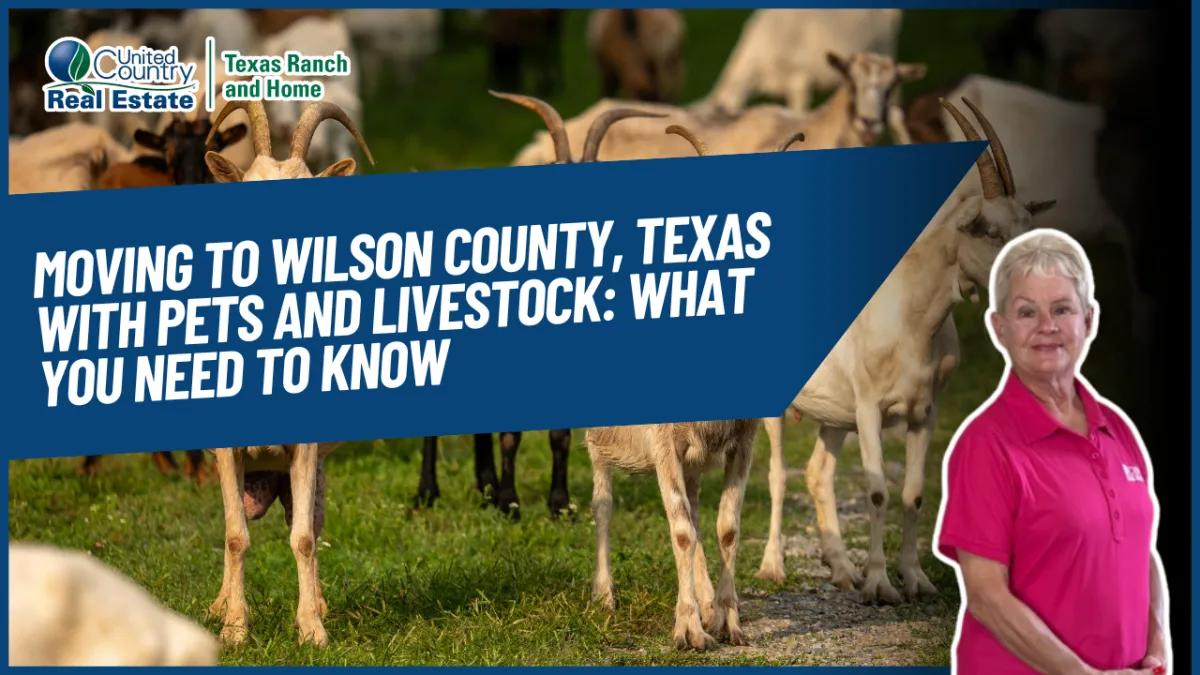
Moving to Wilson County, Texas With Pets and Livestock: What You Need to Know
One of the most consistent themes in conversations with buyers considering a move from San Antonio to Wilson County is animals. Dogs who need room to run. Horses they've always wanted to bring out of boarding. Chickens. Goats. Cattle they've been dreaming about.
Wilson County is absolutely the right destination for buyers who want to live alongside animals — the rural residential properties throughout the county are specifically suited to it, in ways that San Antonio's suburban neighborhoods simply cannot match.
But moving to Wilson County with animals — particularly livestock — requires specific planning that buyers who've only ever lived in urban or suburban environments sometimes underestimate.
Barbara Peterson is the broker-owner of United Country Real Estate | Texas Ranch and Home in Floresville, Texas. She has helped hundreds of families make the Wilson County move — many of them with animals in tow. She lives here. She works here. This guide covers what every buyer needs to know before arriving in Wilson County with pets and livestock.
Moving With Dogs: The Good News and the Preparations

The good news for dog owners: Wilson County rural residential properties are among the best environments for dogs in the San Antonio region. Space to run, things to explore, outdoor lifestyle that dogs thrive in.
What to plan for:
Fencing adequate for your dog's specific characteristics. This is the most critical first consideration. A standard cattle fence (barbed wire) is not adequate for most dogs — they can go through or under it. Before moving your dogs to a Wilson County property, confirm the fencing will contain them specifically, or plan the fencing improvements before moving day.
For properties with existing fence that isn't dog-adequate, options include:
Adding a secondary perimeter of welded wire or no-climb fencing inside the existing cattle fence
Installing a dedicated yard fence around the home site using chain link or wood board fencing
Electronic fence systems as a supplement (not replacement) for physical barriers
Heartworm and parasite prevention is critical in South Texas. Wilson County's warm climate and mosquito population make heartworm risk a year-round concern. Dogs should be on veterinarian-recommended heartworm prevention monthly without fail. Also consult your vet about South Texas-specific parasite and tick prevention — the tick population in Wilson County is significant, and some tick species transmit ehrlichiosis and other diseases.
Rattlesnake awareness. Wilson County has rattlesnakes — primarily Western Diamondbacks. Dogs who explore freely in brush or rocky areas are at risk. Rattlesnake avoidance training is available from Wilson County-area trainers and is strongly recommended for dogs who will range freely. Rattlesnake vaccine for dogs is available from veterinarians and is recommended for rural South Texas dogs.
Finding a Wilson County-area veterinarian. Floresville has veterinary clinics — identify and establish a relationship with a local vet before you need one in an emergency. Ask neighbors or the Wilson County agricultural extension office for recommendations.
Moving With Cats: Indoor vs. Outdoor Considerations
Cats who move from urban environments to rural Wilson County face a specific set of risks that owners should understand:
Outdoor cats in Wilson County face predators. Coyotes, great horned owls, and other predators that rarely interact with suburban cats are active in Wilson County rural areas. Outdoor cats — particularly kittens and smaller cats — are at genuine risk from coyote predation, especially at night. Barbara is direct about this with cat-owning buyers: outdoor cats in rural Wilson County have significantly shorter average lifespans than urban outdoor cats, and indoor-only cats are at much lower risk.
Rattlesnake risk applies to cats as well. Cats that explore brush and rocky areas encounter the same rattlesnake risk as dogs.
FeLV and FIV testing for cats acquired from agricultural areas. If you're adopting cats from farm environments (barn cats, agricultural property cats), have them tested for Feline Leukemia Virus and Feline Immunodeficiency Virus before introducing them to existing household cats.
Moving Horses to Wilson County: The Complete Planning List

For buyers who are bringing horses to Wilson County — or who are purchasing Wilson County specifically for their horses — the move involves specific logistical and property planning.
Property requirements: As covered in our dedicated horse property blog, horses need:
Safe horse fencing (pipe, no-climb woven wire, or board fencing — not barbed wire)
Adequate shelter from summer heat and afternoon sun
Distributed water access
Appropriate acreage for the number of horses (minimum 5 acres for 1–2 horses with supplemental feeding)
Before the move:
Health certificates and Coggins test. Moving horses across state lines (even from another state) into Texas requires a current Certificate of Veterinary Inspection (CVI) from an accredited veterinarian, valid within 30 days of the move. Within Texas, a Coggins test (equine infectious anemia) is required for most horse transport.
Finding a Wilson County-area large animal veterinarian. Large animal veterinary services are available in the Floresville/Wilson County area — but establish a relationship with a local equine vet before you need emergency care. Ask neighbors or the Wilson County 4-H extension office for recommendations.
Quarantine period for new arrivals. If you're bringing horses to a property that already has horses, a quarantine period of 2–3 weeks is advisable to prevent disease transmission before introducing new animals to the existing herd.
Hay supply. Have a hay supply plan in place before you arrive — particularly if you're moving during summer or early fall when South Texas hay production is finishing the season. Know who your hay supplier will be and where you can get emergency supply if needed.
Moving Livestock to Wilson County: Cattle, Goats, Chickens, and Pigs

Cattle:
Moving cattle to Wilson County requires:
Texas brand registration if applicable (brands are recorded with the Texas Animal Health Commission)
Health certificates for interstate transport
Adequate working infrastructure at the destination — working pens, loading facility for future management
Water access confirmed before cattle arrive — don't move cattle to a property without verified, functional water sources
Contact the Texas Animal Health Commission (TAHC) for current requirements on cattle movement documentation.
Goats and sheep:
Goats are becoming increasingly common on Wilson County small acreage properties — for weed control, pet interaction, and small-scale agricultural use. Important considerations:
Goats require fencing that keeps them in AND predators out. Standard cattle fencing is inadequate for goats. Woven wire fence with small mesh openings is the standard goat fence.
Coyote predation of goats is significant in Wilson County — particularly for small breeds and kids. Great Pyrenees and other livestock guardian dogs are commonly used by Wilson County goat owners for predator protection.
Goats are susceptible to internal parasites (barber pole worm particularly) in South Texas's warm climate. A herd health management program with a large animal vet is essential.
Chickens:
Backyard chicken flocks thrive in Wilson County — and they're one of the most common additions families make when they make the rural move.
Important considerations:
Predator protection is critical. Foxes, raccoons, opossums, hawks, and coyotes all prey on backyard chickens in Wilson County. A properly secured coop and run — with hardware cloth (not chicken wire, which predators can breach), a latch that raccoons can't open, and overhead protection — is essential.
Heat management in summer. Wilson County summer temperatures exceed 100°F regularly. Adequate shade, ventilation, and fresh water management are critical for chicken flock health from June through September.
Pigs (including potbelly pigs):
Feral hog pressure in Wilson County means that domestic pigs — even potbelly pets — should be kept in secure enclosures that prevent commingling with feral hog populations. This protects your domestic animals from disease transmission and prevents domestic pigs from escaping and adding to the feral population.
Deed Restrictions and HOA Restrictions on Animals

For buyers purchasing in Wilson County planned communities (Woodbridge Farms, Shannon Ridge, Heritage Woods, Chaparral Ranch, Pradera Ridge), confirm deed restrictions regarding animals before assuming rural freedoms apply.
Common restrictions in Wilson County planned communities:
Livestock (including chickens, goats, and cattle) may be prohibited
The number of dogs may be limited
Certain breeds may be restricted under HOA rules
Barbara confirms deed restriction animal provisions for every buyer — particularly those moving with animals or planning to acquire livestock after purchase.
South Texas Wildlife Your Animals Will Encounter

Wilson County's wildlife is one of the joys of rural living — and a practical consideration for pet and livestock owners:
Rattlesnakes: Present throughout the county. Most active April through October. Keep pets and livestock away from rocky terrain and brush piles during warm months.
Coyotes: Active throughout the county. Primary predator of cats, small dogs, goats, sheep, and chickens. Management through trapping, livestock guardian dogs, and secure nighttime enclosure.
Fire ants: A constant presence in South Texas. Keep dogs and livestock out of fire ant mounds. Fire ant stings are painful and can cause allergic reactions in sensitive animals.
Feral hogs: Present throughout Wilson County. Can be aggressive when cornered or when protecting young. Keep smaller pets away from brush areas where hogs may be active.
Ready to Make the Move to Wilson County With Your Animals?
Barbara Peterson Broker/Owner — United Country Real Estate | Texas Ranch and Home Floresville, TX 78114
📞 Barbara: 210-540-6487 🌐 www.txranchandhome.com 📅 Schedule a Free Buyer Consultation with Barbara
We live here. We work here. Wilson County is genuinely great for animals — and knowing what to plan for makes the move successful.
Barbara Peterson is broker-owner of United Country Real Estate | Texas Ranch and Home in Floresville, Texas. She specializes in residential real estate across Wilson County and South Texas.