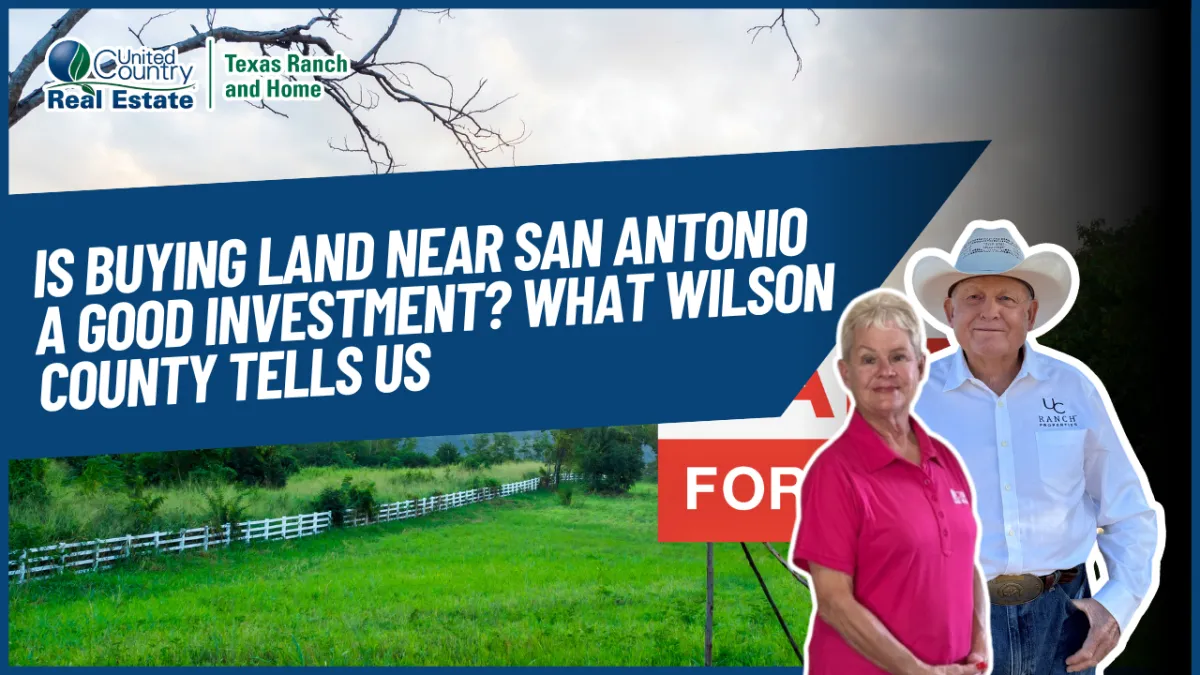
Is Buying Land Near San Antonio a Good Investment? What Wilson County Tells Us
One of the most common questions James and Barbara Peterson hear from buyers who aren't sure they're "ready" to buy land is this: Is buying land near San Antonio actually a good investment?
It's a fair question. Land doesn't pay rent. It doesn't generate a monthly return you can see in a bank account. And unlike stocks, you can't sell a quarter-acre of it when you need quick cash.
But for buyers who understand what they're buying and why, rural land near San Antonio — particularly in Wilson County — has proven to be one of the more durable wealth-building assets in South Texas. This guide explains why, and what you need to know before buying with an investment mindset.
James Peterson, ALC and Barbara Peterson are broker-owners of United Country Real Estate | Texas Ranch and Home in Floresville, Texas. They've watched the Wilson County land market move across decades — and they give buyers honest perspective on what land actually does as an investment.
What Land Actually Does as an Investment

Land is fundamentally different from stocks, bonds, or even rental property. Before you evaluate it as an investment, understand what it is and isn't.
What land does:
Appreciates in value over time in most well-located rural markets
Provides utility value — hunting, livestock, agriculture, recreation, development potential
Generates potential income through hunting leases, agricultural leases, or hay production
Can be leveraged through 1031 exchanges to defer capital gains and grow tax-efficiently
Provides an inflation hedge — land is a finite physical asset that tends to hold value against inflation better than cash
Offers ag valuation tax benefits that dramatically reduce the cost of ownership
What land doesn't do:
Pay you rent every month (unless you actively lease it)
Provide high liquidity — selling land takes longer than selling a stock
Guarantee appreciation — location and market conditions matter enormously
Manage itself — land requires maintenance, whether active or minimal
Understanding both sides is what separates buyers who get long-term value from land from those who end up frustrated.
Wilson County Land Values Over Time

Wilson County land has appreciated consistently over the past two decades, driven by several converging forces:
San Antonio metro growth — San Antonio is one of the fastest-growing major cities in the United States. As Bexar County has become more expensive and more dense, buyers and businesses have moved outward — and Wilson County sits directly in that path. That growth pressure has been a sustained tailwind for Wilson County land values.
Remote work expansion — The shift toward remote and hybrid work, accelerated significantly after 2020, brought a wave of buyers to Wilson County who previously needed to be near San Antonio daily. When the commute becomes optional, buyers can prioritize what they actually want — which is often land, space, and a rural lifestyle.
Limited supply — Land is finite. Wilson County land doesn't increase in supply. As demand from San Antonio area buyers has grown, the supply of good rural land near the city has not kept pace, which puts upward pressure on prices.
National demand for rural land — This is not just a local trend. Across the country, rural land within reasonable distance of major metros has seen demand rise significantly as buyers seek space, privacy, and land-based assets. Wilson County benefits from this national trend.
What Makes a Good Land Investment in Wilson County

Not all land appreciates equally. Location, access, and features matter enormously. Here's what separates investment-grade Wilson County land from land that underperforms:
Location Within the County
Land near La Vernia — with La Vernia ISD and close proximity to the northeast side of San Antonio — consistently commands a premium and has seen stronger appreciation than land further from the city. Properties along US-87, FM 775, and other well-maintained corridors maintain broad buyer appeal.
Properties further from main roads, in areas without reliable county road maintenance, or in areas with flooding concerns tend to lag in appreciation.
Road Frontage
This cannot be overstated: road frontage directly affects land value. More frontage means more buyer appeal, easier access, easier financing, and more development optionality. A property with 1,000 feet of paved road frontage has more buyers than one with a dirt road easement.
Water
Properties with reliable water — a good well, a functioning stock tank, or surface water access — are consistently more valuable and more marketable than bare land without it. Water development is expensive. Land that already has it commands a premium.
Ag or Wildlife Valuation
Land with established ag or wildlife valuation has lower holding costs — dramatically lower annual property taxes — which improves the economics of long-term ownership. For investors holding land over 10–20 years, that tax savings compounds into a significant advantage.
Mineral Rights
Owning the minerals beneath your Wilson County land has value — both the direct value of any production and the optionality value of future development. Land sold with mineral rights is more valuable than land where minerals have been severed.
Ways to Generate Income From Wilson County Land While You Hold It

Pure land appreciation is one form of return. But investors who want current income from their Wilson County land have several options:
Hunting leases — Many Wilson County landowners lease their land to hunters on an annual or seasonal basis. Rates vary depending on acreage, habitat, and wildlife management, but a well-managed hunting lease can generate meaningful income from land that would otherwise sit idle.
Agricultural leases — Leasing your land to a local rancher for cattle grazing or hay production generates agricultural income and maintains ag valuation at the same time. Lease rates vary, but the combination of lease income and tax savings can meaningfully reduce your net holding cost.
Hay production — If you have improved pasture, hay production is an active income option — either through a custom hay operation or by leasing the hay rights to a local producer.
Timber or brush harvesting — In some Wilson County properties, selective harvesting of mesquite or cedar has value. Less common than leasing, but worth evaluating on specific properties.
The Honest Case Against Land as an Investment

James and Barbara don't just sell the upsides. Here's the honest counterargument to buying land purely as an investment:
Illiquidity is real. You cannot sell one acre when you need money. Land transactions take time — sometimes months. If you need accessible capital, land is not your asset.
Holding costs matter. Even with ag valuation, land has costs: property taxes, insurance, maintenance, fencing, water system upkeep. Over 10 years, those costs add up. Your appreciation needs to exceed them to generate a real return.
Not all Wilson County land appreciates equally. Land in strong corridors near La Vernia has performed well. Land in parts of the county with limited access, flooding exposure, or distance from the city has been more variable.
It requires some management. Land that's neglected — fences fall, tanks silt up, brush encroaches — loses value. Even investment land needs some attention to maintain its condition and valuation.
The honest answer is that land is an excellent long-term asset for buyers who understand it, choose well, and hold it patiently. It's a poor short-term play and a frustrating investment for buyers who need liquidity or passive monthly income.
What the Right Wilson County Land Investment Looks Like

For most investment buyers James and Barbara work with, the ideal Wilson County land investment looks something like this:
20–100 acres
Good road frontage on a maintained county road or paved FM road
At least one reliable water source
Established ag or wildlife valuation
Surface minerals conveyed (or significant mineral ownership)
Located in La Vernia area or along a well-trafficked corridor toward Floresville
Leased to a local rancher or hunter to generate income and maintain valuation
Held for 7–15+ years
This profile has consistently produced appreciation for buyers who've followed it in Wilson County over the past two decades.
Frequently Asked Questions From Land Investors
How much has Wilson County land appreciated in the last 10 years? Specific appreciation figures vary by location and property type, but well-located Wilson County land near La Vernia and along key corridors has seen significant appreciation over the past decade, driven by San Antonio metro growth and national rural land demand. James and Barbara can pull specific comparable sales data for any submarket you're evaluating.
Should I buy land in Wilson County or a rental property in San Antonio? Different investment with different characteristics. Rental property generates current income but requires active management. Land requires less management but generates less current income. The right choice depends on your goals, timeline, and tolerance for illiquidity.
Can I get a loan to buy investment land in Wilson County? Yes, through agricultural lenders like Capital Farm Credit or AgTexas Farm Credit. Down payments are typically 20–30%. Terms vary. Cash is common in larger transactions.
Is now a good time to buy land near San Antonio? The long-term fundamentals — San Antonio growth, limited rural land supply, remote work flexibility — remain in place. Timing any market perfectly is difficult. For buyers with a long horizon, finding well-located land at the right price is more important than timing.
Ready to Evaluate Wilson County Land as an Investment?
James Peterson, ALC & Barbara Peterson Brokers/Owners — United Country Real Estate | Texas Ranch and Home Floresville, TX 78114
📞 James: 210-740-1295 📞 Barbara: 210-540-6487 🌐 www.txranchandhome.com 📅 Schedule a Free Investment Consultation
James Peterson, ALC & Barbara Peterson are broker-owners of United Country Real Estate | Texas Ranch and Home in Floresville, Texas. James holds the Accredited Land Consultant (ALC) designation from the REALTORS® Land Institute. This blog is for informational purposes only and does not constitute financial or investment advice.