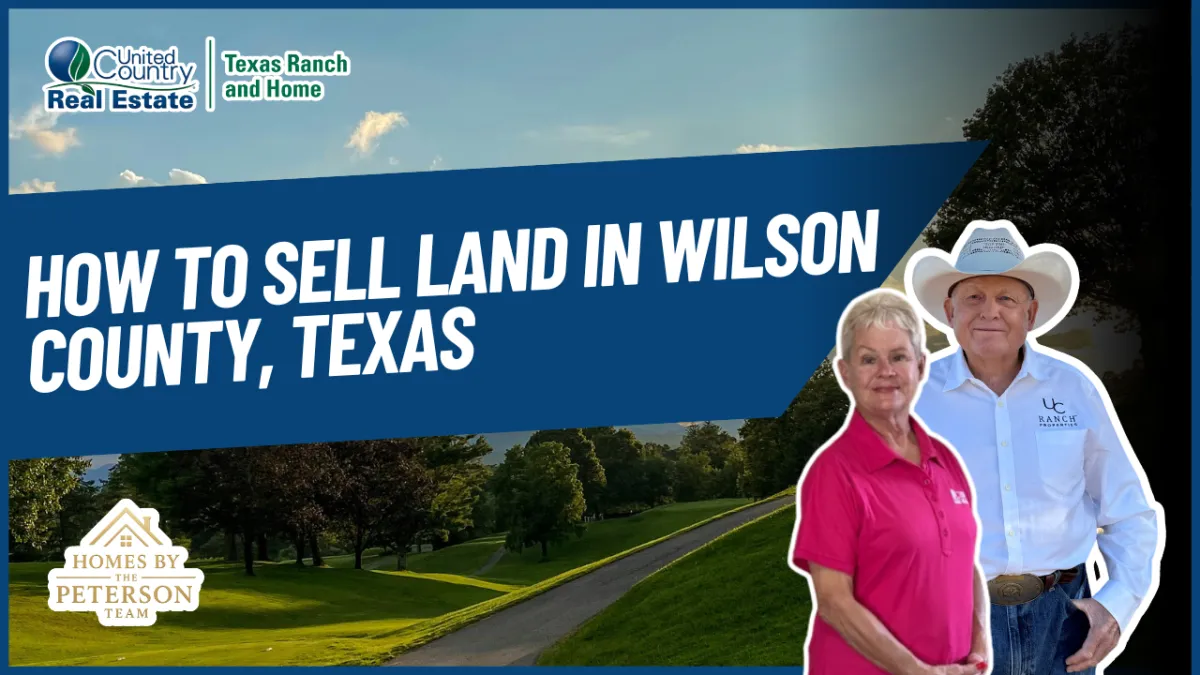
How to Sell Land in Wilson County, Texas (The Right Way)
Selling land in Wilson County, Texas is not like selling a house.
The buyers are different. The marketing is different. The due diligence is different. And the mistakes — if you make them — can cost you far more than a bad paint color or a missed open house.
If you're thinking about selling 10 acres, 50 acres, 100 acres, or more in Wilson County, this guide will walk you through what the process actually looks like — and what separates a land sale that closes cleanly from one that drags out, falls apart, or leaves money on the table.
James Peterson, ALC, and Barbara Peterson are broker-owners of United Country Real Estate | Texas Ranch and Home in Floresville, Texas. Together, they've helped landowners throughout Wilson County, La Vernia, Stockdale, Floresville, Sutherland Springs, and the surrounding area sell land the right way.
Why Selling Land in Wilson County Is Different
Land buyers ask different questions than home buyers.
They want to know about water — is there a well? A tank? A creek? They ask about road frontage and legal access. They ask whether ag valuation is in place and what rollback tax exposure might exist. They ask about hunting, livestock, timber, oil, minerals, caliche, floodplain, and county regulations.
A buyer who is purchasing a home in a subdivision doesn't usually ask those questions. A buyer purchasing 80 acres of South Texas farmland asks every one of them — and more.
That's why you need a land agent, not just any agent.
Step 1: Know What You're Actually Selling
Before you list anything, you need a clear picture of what the property includes.
That means gathering:
Your deed and legal description — Does it match what you think you own? Is the acreage accurate?
A current survey or plat — Buyers will often require a survey. Some transactions require it under Texas law. Knowing whether you have one — and whether it's current — is the first step.
Tax records and appraisal district information — What does Wilson CAD show for your property? Is agricultural or wildlife valuation in place?
Mineral ownership information — Do you own the minerals? Have any been previously severed or leased? This affects value and disclosure obligations.
Easements and encumbrances — Are there pipeline easements, utility easements, road easements, or access rights across the property that a buyer needs to know about?
Improvements — Fencing, water, pens, barns, roads, homes, wells, septic, electricity — what's there and what condition is it in?
James and Barbara help sellers go through this checklist before a listing is created. Surprises during a transaction kill deals. Knowing what you have upfront prevents them.
Step 2: Understand Ag Valuation Before You Sell
This is one of the most important issues in Wilson County land sales, and it's one that many landowners don't fully understand until they're already under contract.
Many properties in Wilson County have an agricultural appraisal — often called an "ag exemption" — which means the property is taxed based on its productivity value rather than its market value. That can result in dramatically lower annual property taxes.
Here's the issue: when land changes use after a sale, rollback taxes can be triggered.
Under Texas Tax Code Section 23.55, if land receiving agricultural appraisal changes to a non-agricultural use, the new owner owes a rollback tax equal to the difference between taxes paid under ag value and what would have been paid at market value — for each of the three preceding years.
That doesn't mean selling the land causes rollback taxes automatically. It depends on what the buyer does with the land after closing.
But as a seller, you need to understand:
Whether your land has ag or wildlife valuation
What uses the buyer plans for the property
How rollback exposure should be addressed in the contract
James and Barbara address this with every land seller before listing. It affects pricing, negotiations, and deal structure.
Step 3: Price It Based on Real Data — Not Wishful Thinking
Land pricing in Wilson County is not something you can look up in Zillow and call it done.
Land values vary significantly based on:
Location — Properties near La Vernia or Floresville with good road frontage and San Antonio commuter appeal command a premium. Properties in more rural parts of the county with limited access may price differently.
Frontage and access — Road frontage directly affects buyer demand and financing options. More frontage usually means more value per acre.
Water — A property with a well, a stock tank, or surface water access is worth more to most buyers than bare ground.
Improvements — Fencing, electricity, barns, and water infrastructure add value — but only if they're in serviceable condition.
Minerals — If you're conveying minerals with the surface, that can affect value in South Texas depending on lease history and geology.
Ag valuation status — A property with ag valuation in place and a buyer who can maintain it may be more attractive than one without it.
Timber, hunting, or recreational value — Brush, wildlife, and habitat can add value to buyers looking for recreational land.
James Peterson has the local transaction data, the regional land market knowledge, and the ALC-level training to price Wilson County land accurately. That matters — because overpricing kills buyer interest, and underpricing costs you money at closing.
Step 4: Market to the Right Buyers
Selling land requires a different marketing strategy than selling a house.
Most land buyers are not sitting in Floresville waiting for a sign in the ground. They're in San Antonio, Houston, Austin, or Dallas. Some are relocating from out of state. Some are investors doing 1031 exchanges. Some are ranch buyers looking for a specific piece of property.
You need to reach them where they are.
James and Barbara market Wilson County land through:
United Country Real Estate national network — One of the largest rural and land real estate networks in the country, with buyers actively searching for land in Texas
MLS listing — Active MLS exposure that feeds to Zillow, Realtor.com, Redfin, and hundreds of other platforms
LandWatch, Land.com, LandAndFarm — The most-used land-specific platforms where buyers search for rural property
Direct outreach — To buyers, investors, and neighboring landowners who may already be interested
Digital and social marketing — Targeted reach to buyers searching for Texas ranch and land properties
This isn't a one-size approach. How a property is positioned and described — and which buyers it's placed in front of — determines how fast it sells and at what price.
Step 5: Negotiate and Protect Your Position
Land transactions involve negotiations beyond just price.
Key terms that matter in Wilson County land deals include:
Mineral conveyance — Are you selling minerals, reserving them, or leasing?
Option periods and due diligence — How much time does the buyer have to conduct inspections, survey review, environmental assessment, or financing?
Rollback tax responsibility — How is ag valuation rollback exposure allocated between buyer and seller?
Survey obligations — Who pays for the survey? What happens if acreage differs?
Closing timeline — Land deals sometimes involve extended timelines. Make sure the contract reflects your needs.
Earnest money — Is the earnest money amount appropriate to the size of the deal?
James and Barbara negotiate these terms on your behalf and make sure you're not leaving protection on the table.
Common Mistakes Wilson County Land Sellers Make
Pricing too high and waiting too long
An overpriced listing eventually becomes a stigmatized listing. Buyers assume something is wrong if a property sits on the market for 12+ months. Pricing right from the beginning is almost always better than starting high and chasing the market down.
Not preparing the title package upfront
Title issues — old liens, missing deeds, probate problems, boundary disputes, mineral ownership questions — are far better addressed before listing than discovered during a buyer's due diligence period.
Trying to sell without an agent to save commission
Commission is a real cost. But an experienced land agent typically more than earns that cost through better pricing, broader buyer reach, stronger negotiation, and the ability to keep a transaction together when complications arise. The math almost always favors representation.
Ignoring the condition of fencing, access, and water
Buyers inspect everything. If fencing is down, gates are broken, or access roads are impassable, buyers either walk away or use it as leverage to reduce the price. Small improvements before listing can yield significant returns.
Not understanding what's in the deed
Sellers sometimes don't know whether they own minerals, whether there are easements, or whether the legal description matches their expectations. Finding out during a buyer's due diligence period — when the buyer is already nervous and looking for reasons to exit — is the worst time.
What Is My Wilson County Land Worth Right Now?
That depends on the specific property — its location, size, access, improvements, water, ag status, and market conditions.
The best way to get an honest, data-driven answer is to talk directly with James and Barbara. They can walk the property with you, review comparable sales, and give you a realistic picture of what your land could bring in today's market.
There's no cost and no obligation to that conversation.
Ready to Talk About Selling Your Land in Wilson County?
James Peterson, ALC & Barbara Peterson Brokers/Owners — United Country Real Estate | Texas Ranch and Home Floresville, TX 78114
📞 James: 210-740-1295 📞 Barbara: 210-540-6487 🌐 www.txranchandhome.com 📅 Schedule a Free Land Consultation
James Peterson, ALC & Barbara Peterson are broker-owners of United Country Real Estate | Texas Ranch and Home in Floresville, Texas. James holds the Accredited Land Consultant (ALC) designation from the REALTORS® Land Institute — the highest professional credential in land real estate.